

Introduction
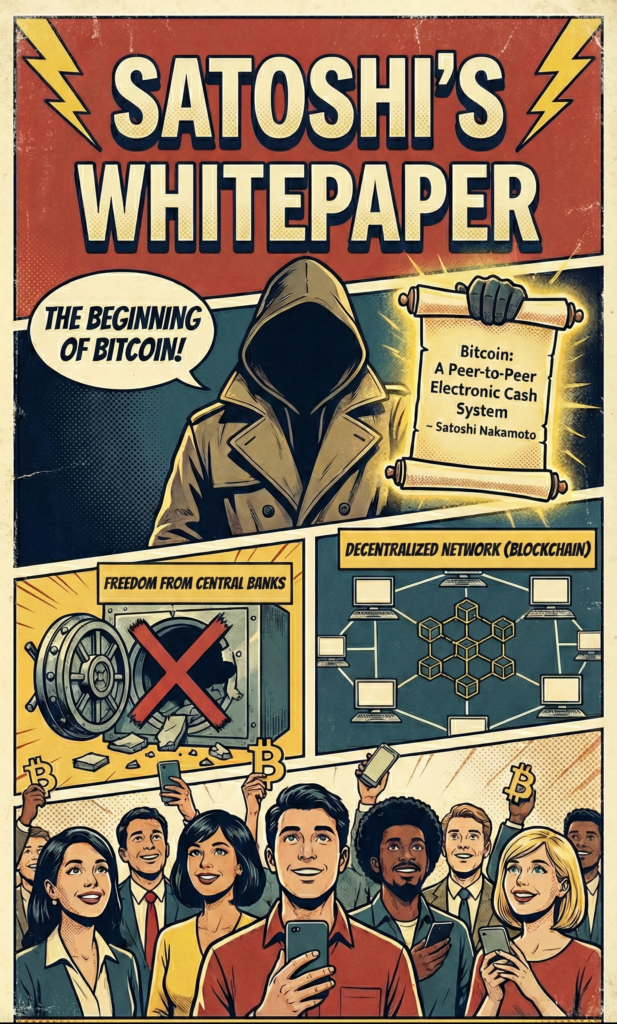
In the digital world so far, a few documents have had a profound impact, such as the Bitcoin Whitepaper, published by the pseudonymous Satoshi Nakamoto in 2008. Titled “Bitcoin: A Peer-to-Peer Electronic Cash System.” It’s a nine-page paper laid within the foundation for a global financial shift.
This was introduced as a functional model for decentralizing digital currency—the concept that technologists had debated for years. Satoshi Nakamoto’s whitepaper is the subject of a deep exploration of its origins, content, technical breakthroughs, and long-term implications.
Background: The Pre-Bitcoin Digital Currency Problem
When Bitcoin wasn’t emerging, the digital payment system was largely controlled. Earlier, banks, payment processors, and financial institutions were the centralized authority behind it, controlling every single money movement. But the introduction of digital payments came to be seen as a convenient option, as they rely on a trusted third party, which makes them vulnerable to fraud, censorship, and system failures.
In the years between the 1980s and the 1990s, cryptographers and computer scientists created digital cash systems, from David Chaum’s DigiCash to later proposals such as HashCash and b-money. These ideas were influential, but none solved the central problem of smart currencies’ function without banks or without being controlled.
It can be double-spending, which occurs when a digital token is copied and spent multiple times. This prevents it by using centralized verification but also creates a dependency on an authority. Then came the need for a way to transact digitally without trusting any central server, which led to the introduction of Satoshi Nakamoto.
Origin of the Whitepaper
Satoshi Nakamoto posted a message on October 31st, 2008, on the cryptography mailing list—a brief description of a new electronic system that needs no central authority. It was during a significant period when global financial markets collapsed, trust in financial institutions and banks was not at an all-time low, and people even questioned how money worked.
Satoshi’s whitepaper wasn’t introduced as marketing hype or a corporate initiative but was launched in a small, technical community with a radical design of digital money.
Objective of the Whitepaper
Satoshi’s goal was clear and straightforward:
For the creation of a decentralized, peer-to-peer electronic cash system, Satoshi’s whitepaper was launched with reliance on no financial intermediaries. It includes certain challenges;
- Eliminating the need for trust
- Preventing double-spending without a central authority
- Ensuring network security even when some participants were malicious
- Creating scarcity in a digital environment
- Incentivizing participants to maintain the system
Key Innovations Introduced
Decentralized Ledger (Blockchain)
It was launched as a distributed public ledger that records all transactions in chronological blocks. Rather than a single central server holding all transaction data, thousands of nodes maintain copies of it. Each of its new blocks is linked up to the previous one, keeping cryptographic hashes. Therefore, it creates a chain that is extremely difficult to alter.
This blockchain structure solved two problems simultaneously:
- It created transparency
- It prevented tampering or fraud
Proof of Work (PoW)
Satoshi’s whitepaper was later adopted and expanded by Adam Back’s HashCash proof-of-work ideation. This requires miners to solve computational puzzles to create new blocks. Therefore, it ensures
- No single entity can control the network
- Participants must expend real resources (electricity and hardware) to add blocks
- Attackers face massive costs to alter the ledger
Consensus Without Trust
Bitcoin nodes follow consensus norms—it’s the same as a traditional system with a trusted authority validating transactions. This is, in reality, the longest valid chain, which later becomes the accepted truth.
The Solution to Double-Spending
To prevent double-spending, this whitepaper’s introduction of Bitcoin’s precise method was the greatest achievement. By broadcasting transactions to the network or requiring confirmation via proof-of-work, Satoshi eliminated the possibility of the same coin being used twice.
Fixed Supply and Monetary Policy
Satoshi’s whitepaper introduces embedded scarcity—something digital files lack. Typically, only 21 million bitcoins will ever exist. This actually differentiates Bitcoin from other traditional currencies managed by central banks.
Whitepaper Structure and Core Concepts
So far, the Satoshi Whitepaper is concise. The key sections include
The paper is concise yet dense with innovation. Key sections include:
Introduction
That identifies the flaws of traditional digital payments and proposes a peer-to-peer system.
Transactions
This focuses on how public keys replace the bank accounts. It even describes how digital signatures verify ownership.
Timestamp Server
It introduces the concept of timestamping data to form an ordered record. This was an important step towards blockchain.
Proof of Work
Proof-of-work shares on mining and how computational challenges secure the network.
Network Functioning
This specifically outlines how nodes interact, broadcast transactions, and arrive at consensus.
Incentives
This key concept shares how miners check newly created and launched bitcoins, aligning personal benefit with network security.
Privacy
Explains pseudonymity—users’ identities are protected, but transactions are public.
Calculations for Attack Resistance
That Satoshi whitepaper, with its core concepts, also supports a deeper mathematical analysis of how difficult it is for attackers to rewrite the chain.
Implementation and Early Adoption
Two months after publishing the whitepaper, Satoshi launched the Bitcoin Network on January 3rd, 2009, with the Genesis Block. It was embedded with a message referencing the newspaper headline focused on bank bailouts.
The early adopters for this were mostly cryptographers and coders—they studied the whitepaper and later experimented with some software. It was a real transaction that occurred in 2010 when 10,000 bitcoins were exchanged for two pizzas. That moment surprised the market as Bitcoin’s value transitioned from theoretical to real.
Impact and Significance
1. Redefining Trust in Finance
2. Birth of a New Industry
3. Store of Value Narrative
4. Alternative to Centralized Banking
5. Triggering Regulatory and Economic Debates
Criticism and Limitations
The Satoshi Whitepaper does have certain limitations, like
- Energy consumption due to proof-of-work
- Scalability challenges arise when Bitcoin processes fewer transactions per second than centralized systems.
- Volatility is the key because supply is fixed and demand fluctuates
- Pseudonymity plays an imperative role as transactions are traceable
Conclusion
Let’s wind up here, as the Satoshi Nakamoto Whitepaper is widely regarded as one of the most influential documents of the 21st century. In its nine pages, it shares a new way of thinking about money, finances, trust, and digital interactions.
From solving the double-spending problem to designing a decentralized consensus system, the whitepaper has been highly influential among cryptographers and programmers for decades.
Today, Bitcoin has emerged as a reshaping force in finance, technology, and cybersecurity worldwide. Whether Bitcoin becomes a global currency, a store of value, or simply a technological landmark, the whitepaper’s impact is undeniable.