Massive Price Surge: Understanding Why Prices Suddenly Explode in Financial Markets
In any financial market, like stocks or trading, there’s always a massive price surge. It occurs when the price of an asset rises sharply in a short period, surprising traders, investors, and even analysts. Such rises happen in stocks, cryptocurrencies, commodities or forex trading.
The sudden surges are rarely random. Every sharp rise is basically a combination of market psychology, economic factors, and imbalances, with external triggers. If you are a trader, it is important to understand the cause of that sudden price increase, as it helps you make better, more practical decisions that lower the risk of emotional mistakes in trading.
Let’s explain in the blog what a massive price surge in the financial markets actually means, why it happens, how the market reacts, and what all traders need to keep in mind during a rapid rise.
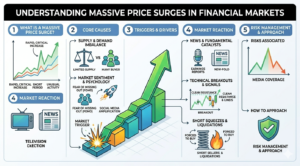
What Is a Massive Price Surge?
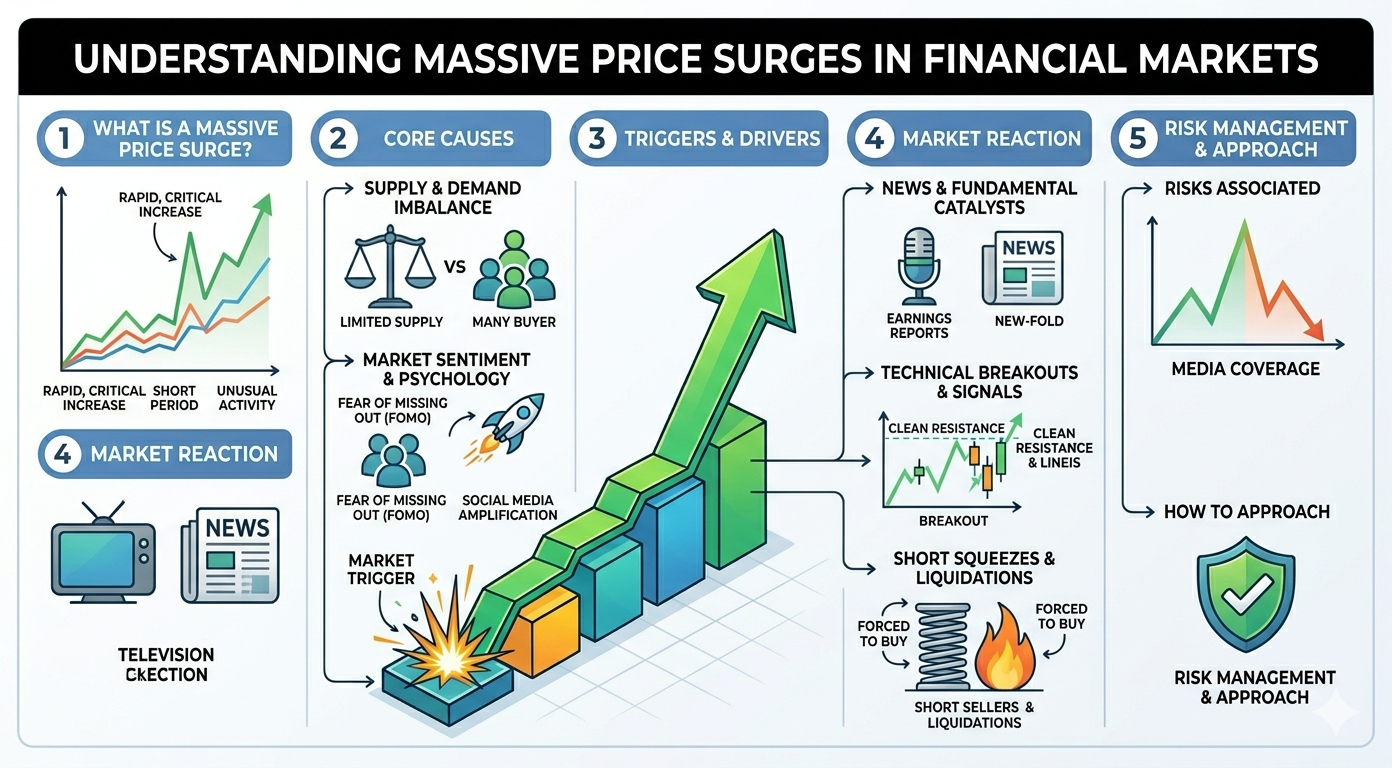
Typically, a massive price surge in financial markets is a rapid, critical increase in the cost of an asset over a short period. The surge in trade is marked by strong momentum, an unusual and unexpected feature in trading activity. Such moves actually break the previous price levels all of a sudden, which gains the attention of traders, analysts, and investors.
That’s why exchange and trading are always called volatile in nature because prices fluctuate from low to even high, doubling and even tripling in minutes. Fundamentals, speculation, or a mix of both can drive these surges.
The Role of Supply and Demand
The core of every movement is actually based on supply and demand. The massive price surge in financial markets is rising sharply and is making things scarce. It happens when new buyers look for market ratios to sell quickly. This makes buyers compete for a limited supply, leading to aggressive price increases.
The sudden increase in demand comes with little flexibility on the supply side, leading to price escalation as well.
Market Sentiment and Psychology
Trading and stocking are games linked to market psychology especially when prices surge. Traders on their way to invest in an asset when it’s on the rise exhibit collective behaviour. Fear of missing out is one of the mistakenly yet strongest emotional drivers among traders, playing an important role in price surges.
The moment the price begins to rise, investors become more active to avoid missing potential profits. It eventually creates a self-reinforcing cycle among traders, driving prices higher and attracting more buyers. In the era of social media and technology, positive sentiment spreads across platforms in seconds, amplified by their algorithms.
News and Fundamental Triggers
The events and new updates do act as catalysts behind the massive price surges. They may include positive earnings reports, regulatory approvals, technological breakthroughs, collaborations and even macroeconomic development theories.
Often, anticipation or predictions of future events also create hierarchy and drive prices even before anything happens officially. The trading market most of the time reacts to news, social media updates, and wrongly expected approaches. When reality exceeds expectations, prices can surge dramatically.
Institutional and Large Investor Activity
The surge in price is also linked with large investors and institutions especially in markets with lower liquidity. Any reputable investor or institution that enters the market sounds almost like a fire alarm for no reason, as they often buy large volumes of trades or stocks in one go. This sudden influx leaves traders overwhelmed and eager to invest, which pushes prices up rapidly. Yet any such involvement builds trust and credibility, so many invest when confidence increases.
Technical Breakouts and Trading Signals
Of course, technical analysis plays an important role in price surges, as many don’t invest easily but watch levels, patterns, and indicators. So when any asset breaks above its resistance level, demand automatically increases, stops losses, and builds a momentum-based buy strategy.
Short Squeezes and Liquidations
The shorter squeezes are also a factor behind the massive price surge in the financial markets. It occurs when traders bet against the asset and are forced or coerced into buying before the price rises. This makes cost surges, and short sellers incur losses. This race to buy and sell adds fuel to the movement and accelerates the surge.
Volume and Liquidity Dynamics
Those sudden price spikes are also due to trading volume. As a high-volume showcase of strong participation and conviction. Yet the low liquidity in dynamics is linked to exaggerated price moves. This is why smaller markets are more often affected by dramatic, unpredictable surges than high-volume markets.
Media Coverage and Public Attention
Media attention and social media influence play a significant role in massive surges, whether in stock prices, trade, or exchange headlines that attract new participants. Mostly, the media coverage that follows the surge also unnecessarily inflates the move. This influx of new buyers further drives demand.
Risks Associated With Massive Price Surges
Everything comes with its cons so do price surges, too. If that creates profit opportunities, it also carries significant risks. The sharp corrections follow the rapid price rise. Thus, late participants buy near the top, which is already a way created by emotional marketing, not by analysis. So when momentum slows, prices fall as quickly as they were increased. That volatility makes many lose when they aren’t planned and executed smartly.
How Traders Should Approach Price Surges?
Firstly, there should be no emotional and sentimental play when trading. The approach with massive surges should be followed up with caution and discipline. Secondly, chasing others without awareness, taking impractical decisions, or being overwhelmed by social and media updates can be risky. You may need to develop a clear strategy to avoid losing thirdly. When trading, risk management is really important to follow. Position sizing, stop-losses, and predefined exit plans help protect capital.
Long-Term vs Short-Term Impact
Not all trade with price surges show the same long-term impact in the market. Some represent the beginning with sustained growth and adoption, and a few may not. The temporary spikes are hyped and speculative, and they fade as quickly as they rise. Therefore, it is important to understand and distinguish between both, as they require deep analysis, patience, and experience.
Conclusion
There is no single, simple factor behind the massive price surge; rather, multiple forces converge at the right moment. To control those factors, like supply-demand imbalance, market sentiment, tech signals & analysis, news, and investor behaviour, all play a vital role. Massive Price Surge in financial markets sounds superb and exciting, but also risky. So a rapid rise in emotional decision-making can be a step toward loss in seconds. Therefore, approaching such surges with knowledge, patience and discipline will not risk your hard-earned money, even during highs and lows in financial markets.
Source: Click Here