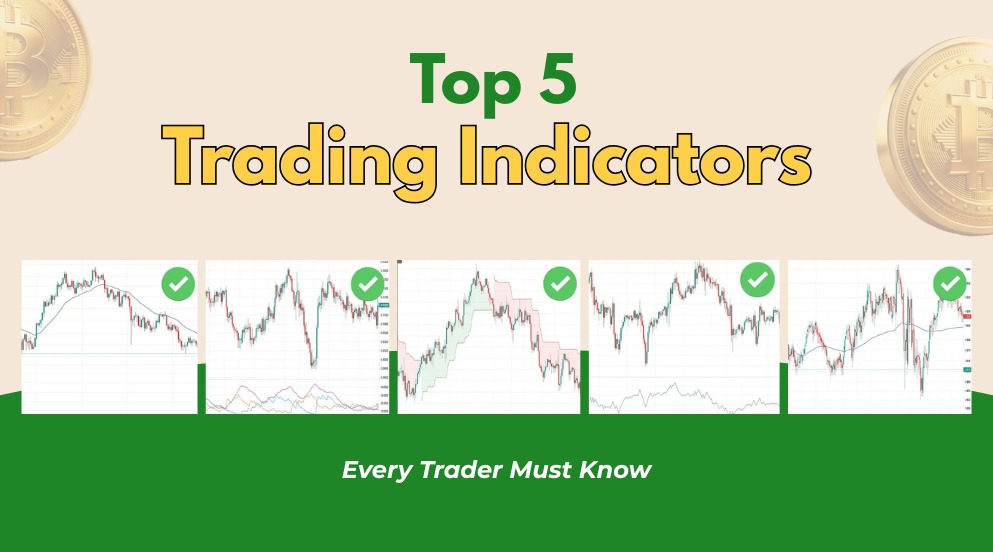
Top 5 Trading Indicators Every Trader Must Know
Trading is something that is all about intuition or luck. Many successful traders do rely on data patterns, tools, and strategies that make it easy to understand market behaviour. In fact, indicators in trading or exchange are important aspects to get better analysis of price movements for precise decisions. Such indicators are based on historical price and volume data, offering real insights into trend, momentum, and strength with potential reversals.
Beginner traders may get overwhelmed, yet experience may be essential for a refined strategy and risk management. Although no indicator or pattern ensures or guarantees profit, understanding them can help in improving consistency and decision-making.
Let’s get you the read that helps in explaining the top five trading indicators that every beginner or experienced trader must know.
Moving Averages
That’s one of the commonly used trading indicators that allows traders to identify the direction of the trend with smoother price fluctuations. Rather than keeping focus on short-term noise, moving averages help in showcasing the average price over a specific time.
Precisely, there are two kinds of moving averages, namely the simple moving average and the exponential moving average. The first one helps in calculating the average cost price over a fixed number of times; the second one helps in giving weightage for recent prices, which makes it more responsive to current market trends.
Mostly, traders use moving averages as a way to identify the pattern of current market trends, like an uptrend or a downtrend. It is even adopted by them for precise indications and crossover signals. This makes it truly helpful, yet it can make some choppy or false signals as well.
Relative Strength Index
The RSI commonly showcases the momentum in trading, which helps in measuring the speed and magnitude of price movements. It even helps traders or investors in determining if an asset is overbought or oversold.
The Relative Strength Index is well calculated over the scale from zero to one hundred, and on average, valuation needs to be above seventy to be considered overbought or below thirty to be considered oversold. Such monitoring ensures identifying the potential of reversal points. To catch momentum shifts, RSI is a widely adopted indicator. A fall in RSI is linked to weaker momentum and vice versa.
Moving Average Convergence Divergence
This is commonly known as MACD as a trend-following indicator. The moving average convergence divergence helps traders showcase the relationship between two moving averages and typically consists of three core components, such as the MACD line, signal line, and histogram. MACD helps traders in identifying trend direction, its momentum, and potential entry and exit points. It even supports knowing spot divergence.
Bollinger Bands
In trading, to keep an eye on volatility, Bollinger bands are widely used by traders. This is a volatility-based indicator that consists mainly of three lines. The middle reflects the moving average, and the upper and lower ones are placed at a certain distance above or below the moving average, with real-time market volatility. Many traders use Bollinger Bands for ease in identifying overbought and oversold trade connections. It even provides assurance for the concept—squeeze. The best use of this indicator helps traders to identify trade volatility and significant price movement, confirm signals, and help in avoiding false trading assumptions.
Volume
It’s another important indicator that is often missed. Yet helps in measuring the number of units traded during a certain period. The volume indicator also helps in offering better insights into the strength behind the price movements in trade. The high volume shows strong interest and activeness, but the low level is weaker in conviction. Volume is particularly useful for confirming breakouts.
How to Use Indicators Together?
Understand this at first as a trader expert—none of the single indicators works best to show the real picture of the trading market. You may need to keep a check and use a combination of indicators for better leads and lower risk. Although using too many indicators is also a complexity that can cause confusion and disturb the analysis. Notably, here is to keeping strategies simpler and well-tested while trading.
Common Mistakes When Using Indicators
The commonly followed, or you can say blindly attempted, mistakes are
- Relying solely on indicators.
- Keep the market context and review ignored.
- Over-optimisation of the indicator is a risk, followed by lesser.
- Not keeping yourself disciplined and practical with trading and the use of indicators.
The Final Verdict: Why Indicators Matter for Traders?
Typically, the use of trading indicators helps in lowering the risk and reducing poor or emotional decision-making. It helps traders to be logical and disciplined with strategies and the use of indicators hand-in-hand. Those only relying on indicators may attempt risks like impulsive trading, which lowers the performance. However, indicators support traders to plan entries and exits and manage risks with current market trends & behaviour.
The core to winning maximum in trading isn’t in finding the perfect indicator but in learning its use, reliability, and existence. This guarantees success and improves trading consistency with practical decision-making.
Read More: Bitcoin – The Future of Money