How ETFs Work: The Simplest Way to Invest in the Stock Market
If you are a beginner, then you will be stuck on investing in the stock market and the exchange. Many believe it requires deep financial knowledge, substantial capital, and constant market monitoring. Well, it does need, but today the development of modern investment tools has made things quite simpler.
One of the easiest ways to enter the stock market is through Exchange Traded Funds (ETFs). That simplicity, flexibility, and reliability make it quite efficient over the popular investment choices. It is important to understand how ETS’s operations can help beginners in trading grow, develop stability, and build wealth over time through effective risk management.
What Is an ETF?
Typically, an ETF is an investment fund that holds a collection of assets, such as stocks, bonds, and commodities, or a mix of different securities. Rather than buying each stock, investors purchase the shares of the ETF as part of ownership. One can go with ETFs traded on stock exchanges like regular stocks, which means you can easily buy or sell them during market hours via a reliable brokerage account.
How ETFs Are Created?
Generally, ETFs are created by financial institutions or asset management companies. Such organizations raise funds by selecting a portfolio of assets that align with specific investment strategies or market indices.
Next, when assets are selected, the fund provider combines them into a single investment product. This allows investors to trade them freely. Big investors known as authorized participants help maintain the ETF’s structure by issuing or redeeming shares in response to market demand. It’s a process that keeps the ETF price aligned with the actual value of the assets it holds.
How ETF Prices Work?
ETFs’ prices change throughout the trading day; that’s what makes them unique, as they are traded in stock exchanges. The rise and fall of prices depends on the market demand for individual stocks. The real value of an ETF is tied to the total value of its underlying assets, referred to as net asset value, which later helps restore the balance. This system helps ensure that ETF prices remain relatively close to the portfolio’s actual value.
Types of ETFs
ETFs come in many forms, allowing investors to pick funds that match their goals and even their risk tolerance.
- Stock ETFs are most commonly opted for. These funds track stock market indexes or groups of companies from specific industries or regions.
- Bond ETFs focus on fixed-income securities such as government or corporate bonds. They are often used by investors seeking regular income or lower volatility.
- Commodity ETFs invest in physical resources such as gold, oil, or agricultural products. These funds allow investors to gain exposure to commodities without directly purchasing them.
- Sector ETFs concentrate on specific industries such as technology, healthcare, or energy. Investors use them to focus on particular areas of the economy.
- International ETFs provide exposure to foreign markets, helping investors diversify beyond their home country.
Why ETFs Are Popular?
Today, ETFs are becoming increasingly popular for many reasons, whether you are a beginner or an experienced investor. Some perks are;
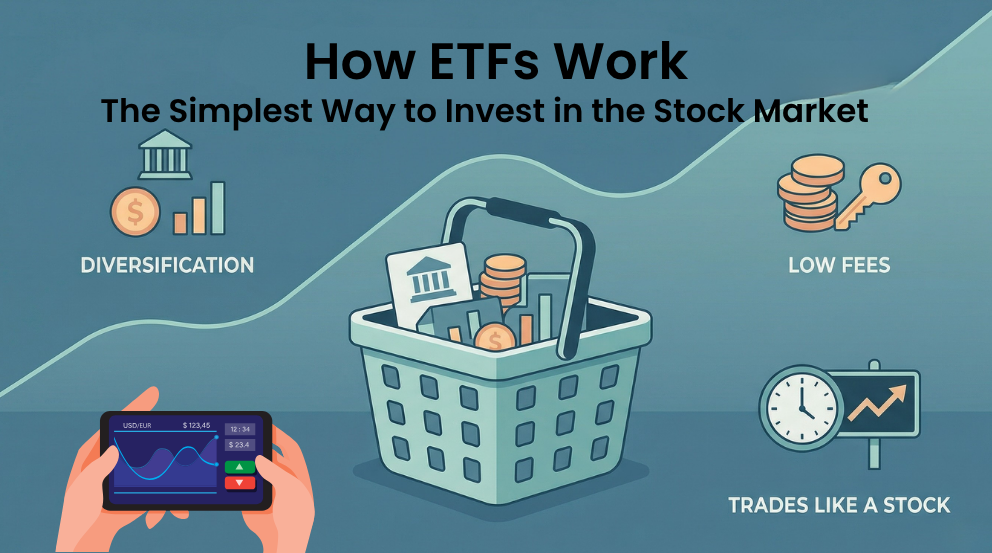
- Diversification: Instead of relying on a single company’s performance, ETF investors spread their money across different assets. It therefore reduces the risk of a single poor-performing investment significantly affecting the entire portfolio.
- The second benefit is cost efficiency; as many need lower management fees, it becomes a passive-income strategy for many. So it works.
- Next comes the high flexibility. ETFs let investors buy and sell with ease during market hours, which is useful for responding to changing market conditions.
- Transparency; is a key factor in ETFs, allowing investors to see the real-time value of their assets.
ETFs Compared to Mutual Funds
There are similarities between ETFs and mutual funds, but they also differ in some ways.
- Mutual Funds: These are priced once a day after the market closes. This allows investors to buy or sell shares based on that single daily price. Mutual funds do have higher fees because of active management and operational costs.
- ETFs: Let’s give traders the ability to buy or sell during the trading hours. It even helps them react quickly to market movements. They even have a lower expense ratio, are managed passively, and offer better tax efficiency.
How Investors Use ETFs?
This actually depends on the individual’s financial goals. Some investors use ETFs as passive, long-term investments. They purchase broad market ETFs and participate in overall market growth without selecting individual stocks. Many look to ETFs to build diversified portfolios of stocks, bonds, and other international assets. It helps balance finances, reduces risk, and maintains growth potential. Talking about experienced ETF investors, most of them want to gain exposure to sectors or trends, which, of course, need deeper research and understanding for beginners; it’s just the easiest way to start investing in something smart and passive.
Risks Associated With ETFs
ETS are considered safer than other financial approaches, such as individual stocks. Yet carry certain risks as follows;
- Market risk is, of course, precise and common.
- ETFs may also focus on narrow sectors or volatile assets.
- Liquidity risk is lower for smaller ETFs, as they have lower trading volume.
- Tracking errors can lead to unexpected risks and losses.
The Final Verdict: The Growing Role of ETFs in Modern Investing
If you want to invest in Traded Funds, then it’s as simple as it plays a role in the global financial system. With growing demand in financial markets, new types of ETFs will emerge, easing investors’ minds to invest in more passive, less risky approaches. So far, it’s a long-term investment tool, but in the future, its diversification, low cost, and simplicity will make more investors consider it for steady, long-term growth.
Source : Click Here