The Rise of AI in Trading: What New Traders Should Know
Advancements and technological developments have now become an inseparable part of the global financial market. The journey from handwritten stock orders to electronic trading platforms has now been shifted to AI. The recent development of artificial intelligence has become one of the most important innovations in the fields of stocks, blockchain, and trading.
The integration of AI in trading has transformed the way we trade, with better data analysis, more effective opportunity identification, and improved risk management. It produces fewer errors, better predictions, and fewer changes in errors than humans, with faster processing of a massive amount of collective data and information. This smart capability is now being valued in global financial markets, where prices change every second, enabling better decision-making in less time.
For new traders looking to grow and achieve stability in their trading, understanding the role of AI is important. Although it provides efficiency and analysis, it also helps in knowing new challenges and risks. Let’s explore more about AI integration in trading and what traders should know about it before using it.
What does AI in Trading mean?
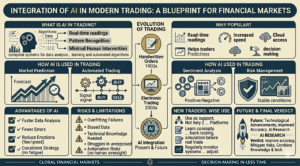
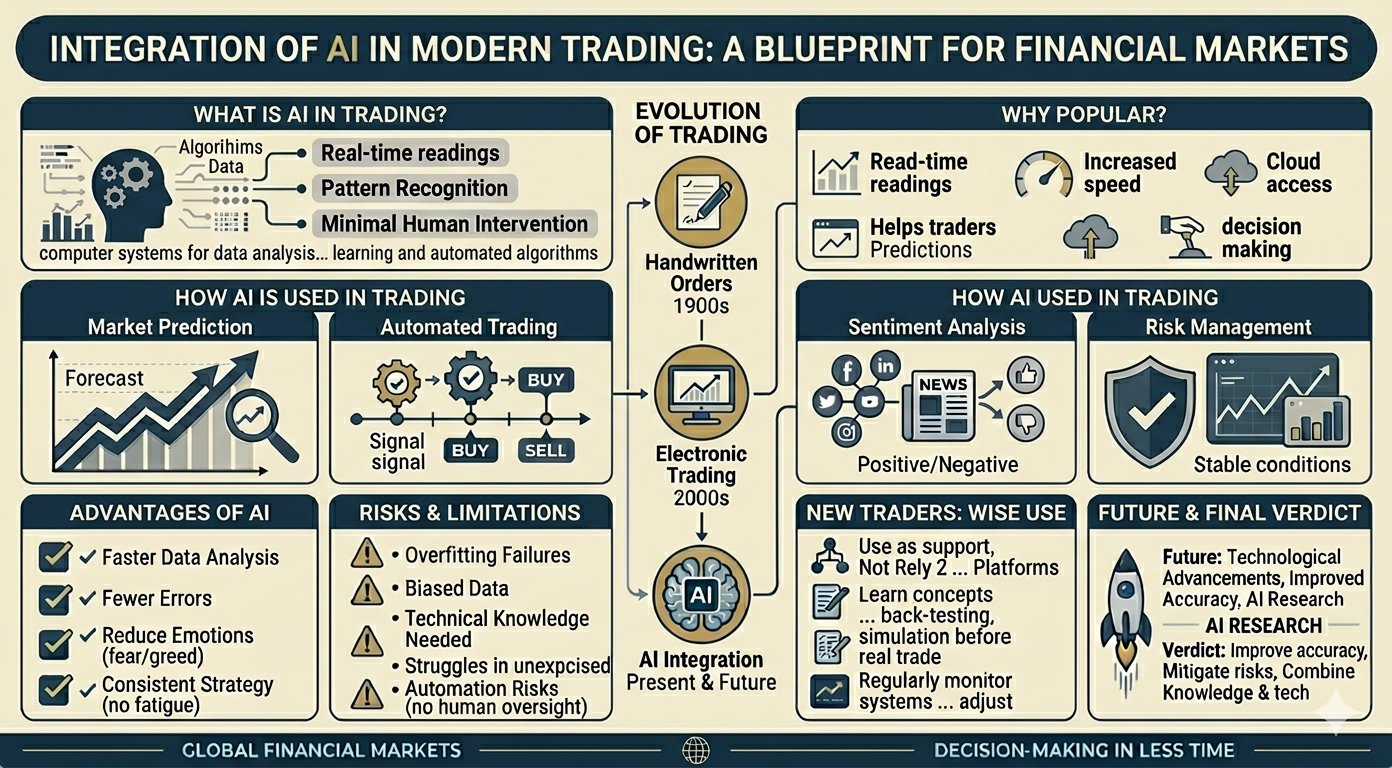
AI in trading refers to the use of computer systems and other technological advancements for data analysis, pattern recognition, and improved decision-making with minimal human intervention. Such systems rely on technologies such as machine learning, data analysis and automated algorithms.
Rather than manual chart study, which is, of course, a lengthy and complex procedure, artificial intelligence analyses large databases and financial reports, including market prices, economic indicators, company news, and social media activity, in less time. The integration of an AI model into trading even helps identify patterns and supports predicting market movements and upcoming opportunities.
Many AI applications and tools provide traders with real-time insights, while others automate trade execution based on predefined strategies. Overall, the primary goal of artificial intelligence in trading is to improve decision-making through advanced data analysis, which is almost impossible for humans to conduct manually.
Why Is AI Becoming Popular in Trading?
There are numerous factors contributing to the growing popularity of AI integration in the financial and trading sectors. Some are as follows;
- Helps traders get real-time readings, analysis, and predictions from data generated and from already available financial reports.
- Support in better and practical decision making with a clear picture of price movements, trading volumes, economic reports and global news.
- Good to identify the patterns in large datasets in seconds, which isn’t possible with human energy and manual resources.
- The integration of AI in trading has increased the speed of financial markets, with automated systems that react faster and think practically in seconds.
- Provides better access to compete with technological advancements such as cloud computing, software tools & applications, and open-source machine learning.
How AI Is Used in Trading?
The application of artificial intelligence can be used for trading in several different approaches, depending on the goal: trading better, observing, or an institution. Commonly, its use for market prediction, combined with machine learning and AI, helps in better analysis of historical price data, supports pattern identification, and indicates future price movements in trade.
Another is its automated trading systems, which enable real-time trading with better execution, automatically based on predefined conditions or AI-studied signals. The more unique approach is the use of artificial trading in sentiment analysis, which involves analysing new articles, financial reports, and social media posts to understand market sentiment.
This works to decode strongly positive or negative interpretations of potential market patterns. AI is also used in risk management to monitor portfolios and adjust positions, helping stabilise conditions for vulnerable individual traders.
Advantages of AI in Trading
- Supports faster data analysis and better trade execution than human traders.
- Ensures processing large amounts of data quickly with zero to minimal errors.
- Helps reduce emotional decision-making, such as fear or greed.
- Maintains consistent trading strategies without fatigue.
Risks and Limitations of AI Trading
- Overfitting can cause models to fail in real market conditions.
- Poor or biased data can lead to inaccurate predictions.
- Requires technical knowledge in programming and data analysis.
- AI may struggle during unexpected market events or crises.
- Full automation without human oversight can increase risks.
How New Traders Can Use AI Wisely
- Use AI tools as support rather than relying on them completely.
- Start with AI-powered analytics or trading signal platforms.
- Learn basic trading concepts like technical analysis and risk management.
- Test strategies using simulation or back-testing before real trading.
- Regularly monitor automated systems and adjust strategies when needed.
The Future of AI in Trading
The implementation of artificial intelligence so far has transformed the trading market and is expected to play an even larger role in the coming years. Technological advancements in machine learning will ease and stabilise trading by enabling better decision-making and faster analysis of massive data.
In fact, it will improve human accuracy and capabilities, enabling better performance in trade and the global financial markets. Many financial institutions have already begun investing heavily in AI research, new trading initiatives, and the development of innovative trading technologies.
Regulators and financial authorities are paying closer attention to automated trading. Ensuring market stability and fairness will remain an important challenge as AI systems become more powerful. For individual traders, the future will likely involve a combination of human expertise and intelligent technology.
The Final Verdict:
The rise of (artificial intelligence) AI in trading has been one of the most precise technological shifts in modern financial markets. From analysing large databases to identifying patterns to executing trades at high speed, AI has almost reached its peak in the financial world.
Although AI isn’t an instant, magically powered tool that promises profits, it’s still a smart approach that must be used carefully and responsibly. By combining traditional trading knowledge with modern technology, traders can leverage AI’s capabilities while mitigating common risks.
Source: Click Here