
When Did Mining Start in Crypto? History of Mining & Its Impact on Cryptocurrency Trading
In cryptocurrency trading, mining is one of the most misunderstood approaches. In fact, many new investors think mining is the same as trading, while some believe that it’s only focused on earning free coins. But reality is different—mining is actually the foundation on which cryptocurrency trading exists.
If there were no mining, there definitely would be no new coins, no verified transactions and no secure blockchain network. Let’s get more details in a case study on how mining is essential in trading and how it started, why its existence matters and how it connects to the broader crypto network.
What Is Cryptocurrency Mining?
In cryptocurrency mining, the process is where digital coins are created, and transactions are verified on the blockchain network. This is a decentralised system on digital platforms and computers, referred to as miners. Cryptocurrency mining is developed to compete to solve complex mathematical problems.
As a reward, mining in cryptocurrency lets miners earn new cryptocurrency with transaction fees. In reality, it encourages mines to keep the network secure and operational. Mining isn’t all about earning coins, but its main purpose is to maintain trust and keep security prior and accuracy within the system.
Why Was Mining Needed?
Earlier, digital money relied on centralised institutions like banks and payment processors—this was all before cryptocurrencies. All these financial institutions are used to verify transactions, prevent fraud and maintain records. This model, however, has many weaknesses, such as high transaction fees, limited accessibility, censorship and the risk of institutional failure.
The major problem among many was double-spending issues, where the same digital currency was copied and used multiple times. At that time, central authorities solved problems by acting as trusted intermediaries.
Mining in cryptocurrency was invented to resolve the issues without relying on central authorities. Therefore, it allows a network of independence to verify transactions.
The Beginning of Mining
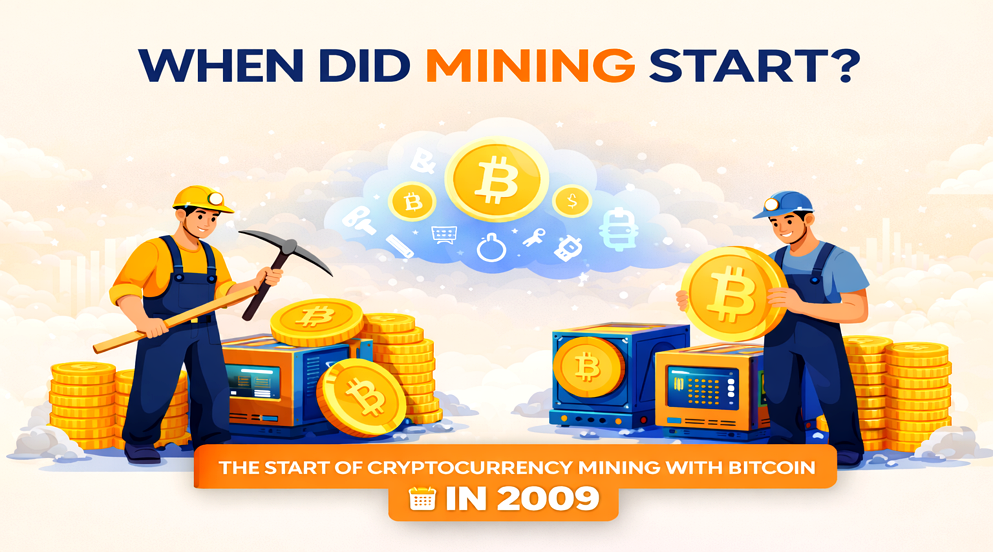
In January 2009, cryptocurrency mining began during the launch of Bitcoin. The creator of Bitcoin, Satoshi Nakamoto, mined the first block of the blockchain, calling it the Genesis Block. This was marked as the birth of the first decentralised digital currency.
Earlier, mining was simple; anybody with a personal computer could do it because the network was small and the competition was lower, with high mining rewards. At that specific time, miners used basic CPUs for securing the network and generating new bitcoins. During that time, mining wasn’t a commercial activity but was casually done by programmers and enthusiasts for the idea of believing in making decentralised money.
How Did Mining Evolve Over Time?
Now, Bitcoin has gained great popularity over time, and thousands of people have joined the network. Therefore, the increased participation has made mining more competitive, leading to major technological changes in mining equipment.
Mining evolved in stages:
- CPU mining, using standard personal computers
- GPU mining, using powerful graphics cards
- ASIC mining, using specialised hardware designed solely for mining
Each of these specific stages increased the efficiency of cryptocurrency mining but also raised its cost. This all happens as mining becomes less accessible for individuals and is dominated by large-scale operations and mining farms.
How Mining Creates Tradeable Assets?
Cryptocurrency mining is the source responsible for its supply. When miners get rewards, they often sell some part of their holdings to cover operational costs like electricity, hardware and maintenance.
Collectively, all these coins or rewards enter cryptocurrency exchanges where traders can easily buy and sell them. It’s all about how mining directly feeds the traders in the crypto market. If there were no mining, then there would be no new coins created entering the cryptocurrency exchange cycle, and trading liquidity would dry up.
Mining also plays a key role in:
- Controlling supply
- Regulating inflation
- Stabilising the issuance of new coins
Mining and Price Discovery
Cryptocurrency mining influences the prices of the coins in many ways. From producing new supply to the cost of mining, it is set within the natural price floor. So if that cost falls below the mining prices, many miners will stop operating and reduce the supply pressure.
On the other side—when the price is raised—mining becomes profitable and attracts more traders and miners. It helps in creating the balance between supply, demand and mining, as a crucial role in price discovery. Mining does not directly set prices, but it strongly influences market dynamics and long-term valuation.
The Link Between Mining and Network Security
Cryptocurrency mining is responsible for securing the blockchain network. Typically, miners verify transactions, prevent fraud and safeguard the network from hacking and attacks from the dark web. Miners participating make operations safer for all, which builds trust among new traders and miners for cryptocurrency trading.
Mining vs Trading: Key Differences
Mining and trading serve very different purposes within the cryptocurrency ecosystem.
Mining focuses on:
- Network security
- Transaction verification
- Coin creation
- Long-term infrastructure support
Trading focuses on:
- Buying and selling assets
- Price speculation
- Short-term or long-term profits
- Market analysis
Challenges in Modern Mining
Today, mining is an essential and inseparable part of cryptocurrency, but it still has certain challenges, such as;
- Energy consumption—the biggest concern, as proof-of-work mining needs proper electricity or backup, which is, of course, not that sustainable every time. This led to innovation for more renewable energy sources and the manufacturing of energy-efficient mining equipment.
- Another major reason is the centralisation of cryptocurrency and mining. Typically, large mining operations do have dominant hash power, which reduces decentralisation. Networks are constantly adjusting rules to maintain balance and fairness.
- Last but not least, regulatory issues are still uncertain, affecting mining operations. Many governments around the world adopt different approaches to cryptocurrency activities.
Why Mining Still Matters Today?
Even when trading volumes grow and financial institutions have entered the crypto space, mining continues to play a significant role. It offers an assured fairness in coin distribution, network security and trust in a decentralised system.
For traders, understanding mining helps explain:
- Why is the supply limited
- Why prices behave cyclically
- Why network health matters
- Why certain coins hold long-term value
Conclusion
Cryptocurrency mining today has been marked as the true beginning of crypto trading. It’s the first decentralised digital asset known today that transformed abstract cryptographic ideas into reality and tradable values. Starting from personal computing systems to large-scale global operations, mining has sculpted a new shape for cryptocurrencies’ functions, growth and trading patterns.
Without mining, there would be no new coins, no secure blockchain, and no trusted system for traders to participate in. While trading captures attention with price movements and profits, mining quietly sustains the entire ecosystem.
Understanding how mining started provides a deeper appreciation of cryptocurrency trading and highlights why mining remains essential even as the industry continues to evolve.