
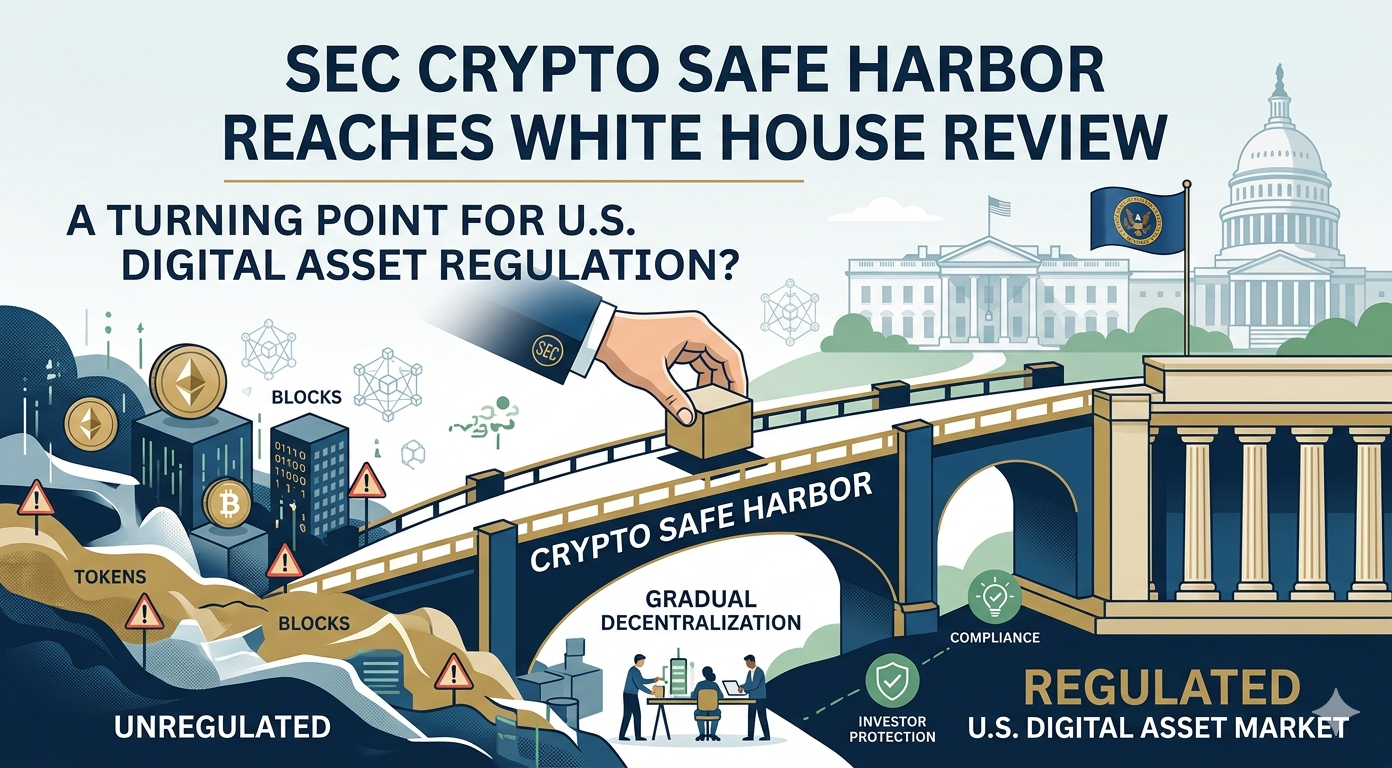
SEC Crypto Safe Harbor Hits White House Review
The discussion of Crypto Regulation in the United States has entered a new phase as a proposed regulatory framework of digital assets by the U.S. Securities and Exchange Commission (SEC) is sent to the White House to undergo regulatory review. These are the signs of increasing pressure on the establishment of a more transparent system of regulations in the fast-changing crypto space.
As revealed in the latest news, the so-called crypto safe harbor framework proposed by the SEC, which notably is a subset within a larger Regulation Crypto Assets effort, has been sent by the Office of Information and Regulatory Affairs (OIRA). This step is one of the final stages in the process of procedures before an official open rule-making procedure is initiated.
To an industry with a long history of uncertainty, this development is a good sign that Structured Crypto Regulation is coming out of the discussion phase and into the implementation phase.
The intention of the Safe Harbor Proposal
The suggested framework is concentrated on one of the fundamental issues of the field of digital assets: the need to control innovation without halting it on the first steps.
According to the current regulations of the finance law, lots of token projects are at risk of being classified as securities as early as they have been launched. This category can be rather rigid in its adherence standards that startups struggling to come up with their technology cannot fulfill anyway.
The safe harbor framework brings about an intermediate method of Regulating Cryptos. Early-stage blockchain projects might be provided with a timeframe of exemption, rather than instant. It was in the course of this period that teams would be offered to establish their networks, give out tokens and be decentralized towards transparency and disclosure.
The concept is uncomplicated – keep innovation growing and preserve the investor protection standard.
The Reason Crypto Companies Are Paying Closer Attention
Cryptocurrency entrepreneurs have long claimed that vagueness in regulations forced innovation out of the country. Multiple blockchain organizations preferred to start their activities in areas with more straightforward regulation contexts instead of taking the risk of being enforced back home.
This trend could be stopped by updated Crypto Regulation according to the supporters. Regulators can also promote homegrown innovation and investment by offering predictable regulations to motivate startups not to leave the United States jurisdiction.
Another important fact about blockchain technology that is identified by the proposal is that decentralization cannot occur overnight. Most of the networks start with leadership that is centralized and with time, changes to community governance. This transition was not designed by traditional securities laws and this is why regulators are thinking about new models.
SEC Chair Paul Atkins has focused on the idea that effective Crypto Regulation does not need to focus on enforcement efforts after projects are launched but rather conduct transparency in their rulemaking processes.
The White House Review Process
Approval by the White House review office is a monumental stage. OIRA appraises key regulatory initiatives to measure the effect on the economy, policies and likely implications on businesses and markets.
In case the framework passes this review phase, the SEC will make the proposal publicly available, and it would become subject to industry discussion and comment. This consultative step will enable companies, investors, scholars, and policymakers to influence the final copy of the rule.
Even though it is not necessary that they will be approved, this stage represents a high level of intentions to develop national Crypto Regulation policies.
Even once under the eye of the world, experts observe that final implementation may require several months. Nevertheless, the results of regulatory clarity by itself tend to be positive in many markets, long before rules are formally enacted.
Future Implication on the Crypto Economy
The safe harbor structure might transform the digital-asset project initiation and functioning in an event of adoption. Some of the potential outcomes are suggested by analysts:
• A private business can have more understandable legal avenues to developing a token.
• Regularized disclosures and enhanced transparency would favor the investors.
• Uncertainty about the regulations of token classifications can be reduced.
• The United States would be more competitive in the innovation of blockchain at an international level.
Many observers interpret the proposal as the bid to make a balance between novelty and responsibility, a balance that was lacking in worldwide Crypto Regulation debates.
A Change in the Tone of Regulation

The shift in the attitude of policy-makers towards digital assets is also expressed in the fact that this proposal was transferred to the White House. Previous arguments used to focus on risk prevention and enforcement. However, now, the regulators seem to be more interested in the creation of the frameworks that would facilitate responsible growth.
Instead of discussing the question of cryptocurrencies having a place in the financial system, the present debate on Crypto Regulation revolves around the problem of how the digital assets can be incorporated safely into the traditional markets.
This emerging attitude may have implications on regulation in other countries including those outside of the United States as international policy makers often refer to the United States standards during the formulation of their own.
What Comes Next
The business awaits the verdict of the white house review. Assuming that the proposal passes the check of being released publicly, it will go through a stage of consultation that potentially will define the future of overseeing digital-assets.
Nevertheless, despite the obstacles and controversies, the development of this framework is one of the most evident indicators to date that complete Crypto Regulation is becoming even closer to a real possibility.
To crypto builders who are interested, crypto investors, and regulators, the next several months may determine the existence of innovation and regulation in the further stage of the digital economy.
Source – Click Here