
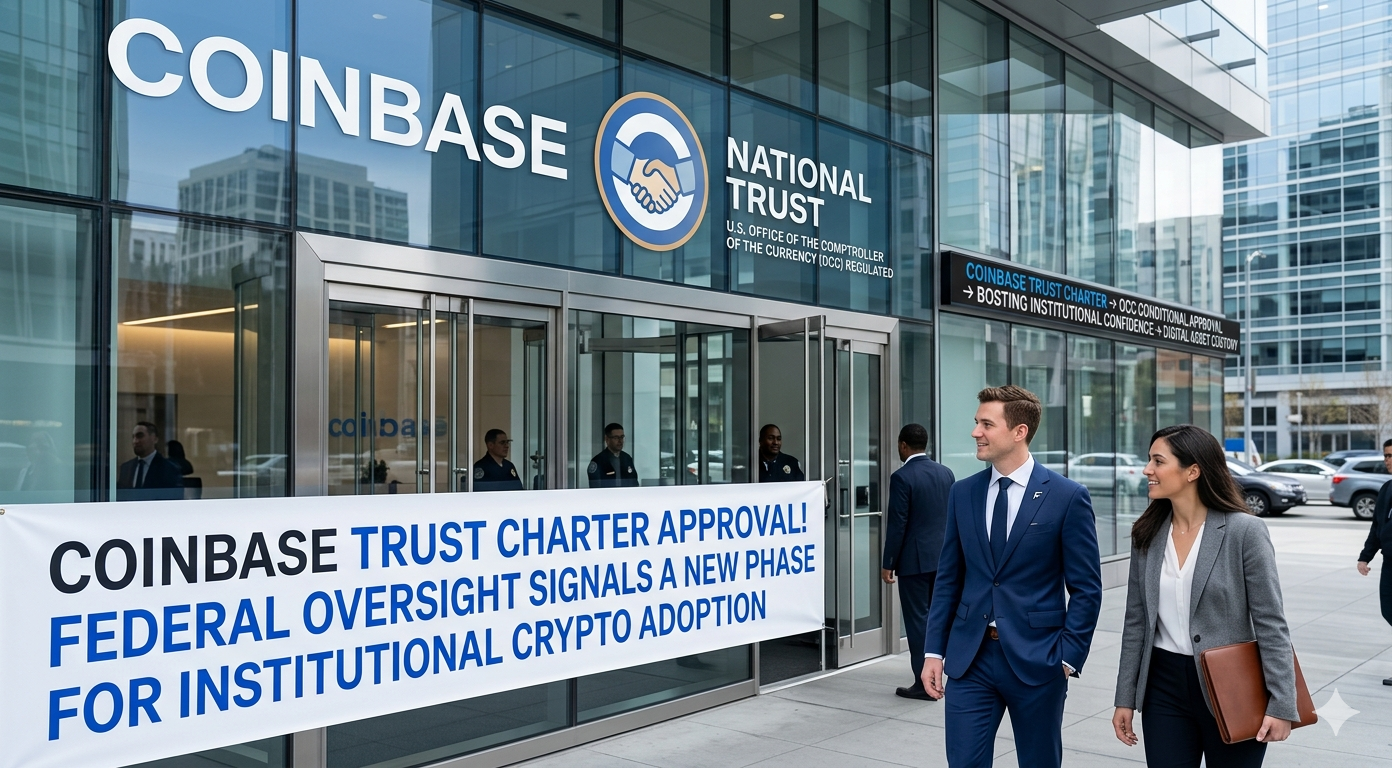
Coinbase Trust Charter Approval Signals New Phase for Institutional Crypto Adoption
Coinbase is one of the cryptocurrency companies that might be entering a more mature stage as it approaches being subject to federal financial regulation in the United States. The recent Coinbase Trust Charter Approval is a major change in the regulation sphere that can transform the interaction between institutions and digital assets.
The reports initially published by Bloomberg and verified by regulatory discussions indicate that Coinbase has been conditionally granted the right by the Office of the Comptroller of the Currency (OCC) in the United States to form a national trust company. Although the verdict is still pending, the Coinbase Trust Charter Approval is one of the most obvious indicators that crypto companies are slowly becoming a part of the conventional financial structure.
The Coinbase Trust Charter Approval Explained
Although there was a certain initial misunderstanding, the approval does not make Coinbase a regular bank. The company will not take retail deposits or provide loans such as commercial banks. Rather, the trust charter would enable Coinbase to become a federally regulated custodian that would store digital assets on behalf of clients.
This difference is significant. The Coinbase Trust Charter Approval is centered on the custody services – safe storage of cryptocurrencies of institutional investors in favor of stringent regulatory rules. In the case of large financial institutions, regulation usually dictates whether they are eligible to be in a market or not.
Moving under federal oversight, Coinbase would be able to substitute various state-based licensing procedures with a national system. Observers in the industry reckon this makes the compliance easy and boosts the confidence of institutional investors.
The Reasons Institutions Are Listening
The institutional adoption is considered to be the next stage of crypto growth, which is delayed by the regulatory uncertainty. Custodians usually must serve federally accepted fiduciary standards, which are usually required by pension funds, asset managers and corporations before capital is allocated.
The Coinbase Trust Charter Approval specifically concerns this problem. A national trust structure regulated by the OCC offers more tangible legal safeguards and transparency in its operations, which makes crypto custody closer to conventional financial services.
To organizations that have been conservative, this change can cause one of the largest barriers to entry, trust in infrastructure and not trust in the technology to be diminished.
According to market analysts, regulatory certainty may tend to bring in long-term capital, and the Coinbase Trust Charter Approval may act to hasten the transition in case of final authorization.
A More Expansive Regulatory Change
The consent also indicates a larger shift in the attitude of the U.S. regulators towards digital assets. Regulators seem to be growing more open to making crypto firms part of the traditional financial system rather than having them remain on the margins following years of hesitation and enforcement-oriented policy.
Other companies have sought such trust designs in recent years, but this case is particularly persuasive due to the size of Coinbase. Being one of the biggest publicly-traded crypto platforms in the world, its regulatory advancement can become a case study of other companies that are striving to gain recognition in traditional finance.
The Coinbase Trust Charter Approval thus has symbolic significance not just to one firm. It is an indication that regulators might be willing to have more controlled supervision than direct prohibition.
What Still Needs to Happen
It is worth mentioning that the approval is conditional. Coinbase has to meet operational, regulatory, and governance conditions before getting ultimate approval to operate its trust entity.
The regulatory reviews are usually characterized by stringent capital requirements, risk management, and internal compliance process. The Coinbase Trust Charter Approval can only be fully effective after satisfying these conditions.
The company is still operating under its current regulatory framework until it is ready to expand under the federal regulation.
A Cryptocurrency Tipping Point?
The Coinbase Trust Charter Approval has the potential to have a long-term effect that goes way beyond the custody services. Should it work, it will potentially serve to bridge the disconnect between decentralized finance and formal markets and motivate more cooperation between crypto platforms and traditional financial institutions.
In the case of the crypto industry, this message is becoming clearer: the growth might rely less on the operation that is not regulated and more on the operations that are regulated.
With the ongoing transformation of digital assets, the emergence of new trends, such as the Coinbase Trust Charter Approval, is an indication that the industry is entering the state of stability, design, and institutionalization, which may become the next phase in the history of crypto.
Source – Click Here