US ADP Non-Farm Employment Change in Focus as Markets Watch US Job Growth Signals
In the high-stakes world of global finance, few reports carry as much weight as the US ADP Non-Farm Employment Change. It isn’t just a collection of statistics; for traders and investors, it’s a monthly “pulse check” on the American economy. As we navigate the complexities of 2026, the labor market has once again become the central focus for anyone trying to predict where interest rates and the US dollar are headed next.
Deciphering the Report
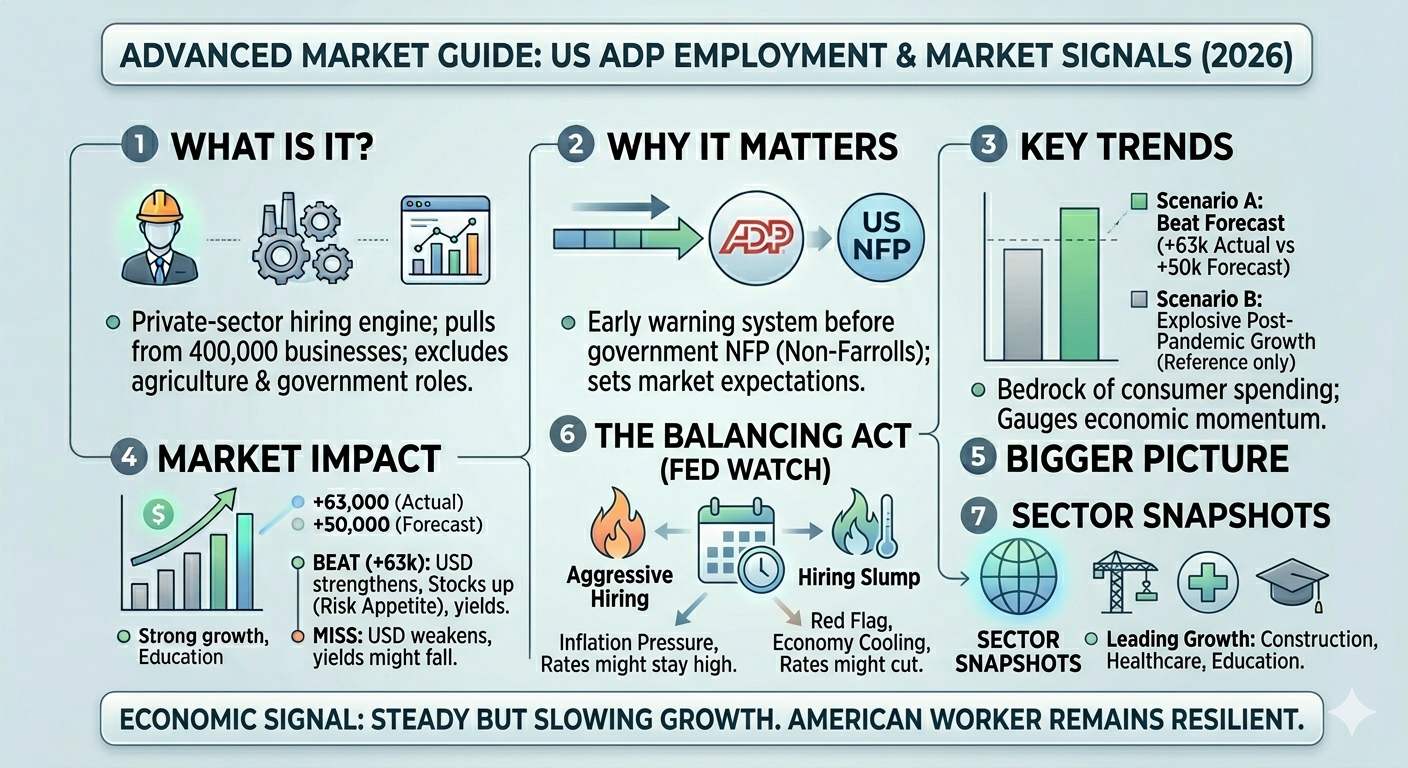
At its core, the US ADP Non-Farm Employment Change tracks the monthly shift in private-sector hiring across the United States. It intentionally leaves out the agricultural sector and government roles to focus on the “engine room” of the economy: private business. By pulling payroll data from nearly 400,000 companies, it offers a massive, real-world sample of how many people are actually being added to payrolls.
But why does a hiring update cause such a stir on Wall Street? It’s because employment is the bedrock of consumer spending. If people have jobs, they spend money. If they spend money, the economy grows. This release usually lands on the desks of traders two days before the official government figures, making the US ADP Non-Farm Employment Change the ultimate “early warning system” for market volatility.
The Market’s “Wait and See” Approach
The importance of these numbers goes deeper than just whether or not people are getting hired. Investors look at the US ADP Non-Farm Employment Change to try and get inside the heads of Federal Reserve officials. Think of it as a balancing act: if hiring stays too aggressive, it keeps the pressure on inflation and makes it harder for prices to drop. On the flip side, if we start seeing a real slump in new jobs, it’s a red flag that those high interest rates are finally starting to bite.
In the current landscape, the gap between what analysts expect and what the report actually shows is where the real action happens. Forex traders, in particular, live for these surprises. A sudden “beat” in the US ADP Non-Farm Employment Change can send the US dollar soaring in seconds, while a “miss” can lead to a quick sell-off in the currency markets.
What the Latest Data Tells Us
Recent snapshots of the labor market have provided plenty of food for thought. Private employers recently added roughly 63,000 jobs, a figure that comfortably beat the 50,000 forecast. Sectors like construction and healthcare are leading the charge, proving that even in a cooling economy, certain industries still have a significant appetite for talent.
However, we have to look at the bigger picture. While 63,000 is a “win” against expectations, it’s a far cry from the explosive growth we saw a couple of years ago. We are seeing a transition—a shift from a frantic, post-pandemic hiring spree to a more measured, balanced pace. This “mixed bag” of steady but slowing growth is why investors analyze the US ADP Non-Farm Employment Change carefully rather than reacting to a single data point.
The Ripple Effect: Stocks and Forex
When the latest figures for the US ADP Non-Farm Employment Change flash on trading screens, the reaction is almost instantaneous. A strong report often strengthens the US dollar as traders expect stronger economic performance, while positive employment data can boost overall investor confidence and risk appetite. Because markets price in expectations so quickly, even small deviations from forecasts can lead to sudden price movements within minutes of the release.
The Bottom Line
As we move through 2026, the labor market remains our most reliable compass. The latest US ADP Non-Farm Employment Change suggests that while the “easy” growth is behind us, the American worker is still resilient. For the person trading on their phone, it’s an opportunity to catch a market move. For the long-term investor, it’s a sign that the economic foundation is holding steady. Ultimately, job growth is more than just a metric; it is the clearest signal we have of the world’s economic health.