
EOS, Chainlink, and Cardano: How These Blockchains Are Shaping the Future
With major developments in the digital world, the cryptocurrency sector has evolved within multiple blockchain platforms over time. Each of them is created to catch and solve specific technological and economic challenges. Earlier, the cryptocurrencies were focused on digital payments; later, with years of popularity, blockchain introduced new capabilities like smart contracts, decentralized applications, and secure data integration.
In the past few years, there have been endless projects that have emerged, and still, three platforms have gained more attention due to their innovative approaches and features like EOS, Chainlink, and Cardano. Each of them comes with certain limitations in blockchain technology, while the other side is expanding its practical applications. Knowing these is little help to illustrate how different blockchains work and solve the problems efficiently.
The Rise of Advanced Blockchain Platforms
After the launch of programmable blockchain networks, most of the developers started exploring ways to enhance performance, scalability, and real-world use of it. Earlier, many struggled with slow transaction speed, high fees, and limited availability.
Yet the new developments have made life easier as we began with the emergence of goals of solving issues that were major earlier. Some get focused on transaction efficiency, enabling smart contracts, emphasizing academic research, and long-term sustainability. EOS, Chainlink, and Cardano represent three different approaches to blockchain innovation.
EOS: A Platform Built for Speed and Scalability
Typically, EOS was introduced on a blockchain platform to support decentralized applications with high-end performance and scalability. It was developed with the aim of creating an environment for developers to create large-scale applications. The key feature of EOS is the consensus mechanism known as delegated proof of stake.
The next aim of EOS was to make blockchain development easier. It ensures providing tools, framework, and resources that let coders or developers build decentralized applications with minimal technical barriers. This was one of the precise creations of new blockchain-based services.
EOS even came up with a unique resource allocation model. Rather than paying transaction charges for each action, many allocate network resources. The model was launched to eliminate the unpredictable transaction cost. Although it faced some criticism regarding decentralization, it remained important in blockchain technology for large applications.
However, EOS has faced criticism regarding decentralization. Because the network relies on a relatively small number of block producers, some critics argue that this structure concentrates power within the system. Despite these debates, EOS remains an important example of attempts to scale blockchain technology for large applications.
Chainlink: Connecting Blockchains to Real-World Data
Smart contracts use blockchain technology to automatically execute agreements when certain conditions are met. Yet they do have certain limitations, as they aren’t directly accessible to any information outside the blockchain.
Chainlink was introduced to manage this challenge by offering a decentralized oracle network. Oracles are specific systems that help in delivering the external data to blockchain applications and platforms, which have gathered information from multiple sources and verified it before sending it to the blockchain. It’s a kind of process that ensures reliability and lowers the risk of incorrect or manipulated data. Chainlink provides secure price feeds that allow these platforms to operate safely.
Apart from finances, Chainlink is also widely used in applications including insurance, gaming, supply chains, and cross-chain communications. In recent years, it has expanded the capabilities of smart contracts and decentralized applications.
Cardano: A Research-Driven Blockchain Ecosystem
The development of Cardano was made with a unique philosophy compared to other blockchain projects. Rather than focusing primarily on rapid blockchain development, Cardano even emphasizes academic research programs and peer reviews, while keeping security standards strong and encrypted.
This wholesome project was launched to create a secure and scalable blockchain infrastructure supporting complex applications, while maintaining strong security standards. The only drawback with Cardano is its development process—before implementing the new features, many researchers need to conduct academic studies and publish findings for peer review. It’s an approach that aims to ensure technology is thoroughly tested and validated.
It even focuses on real-world adoption in regions where traditional financial infrastructure is limited. In recent years, Cardano has evolved within partnerships and initiatives related to digital identity systems, educational credentials, and financial services. Although sometimes processed more slowly than other blockchain technology projects, it still has a stronger and longer-term foundation.
Comparing the Three Projects
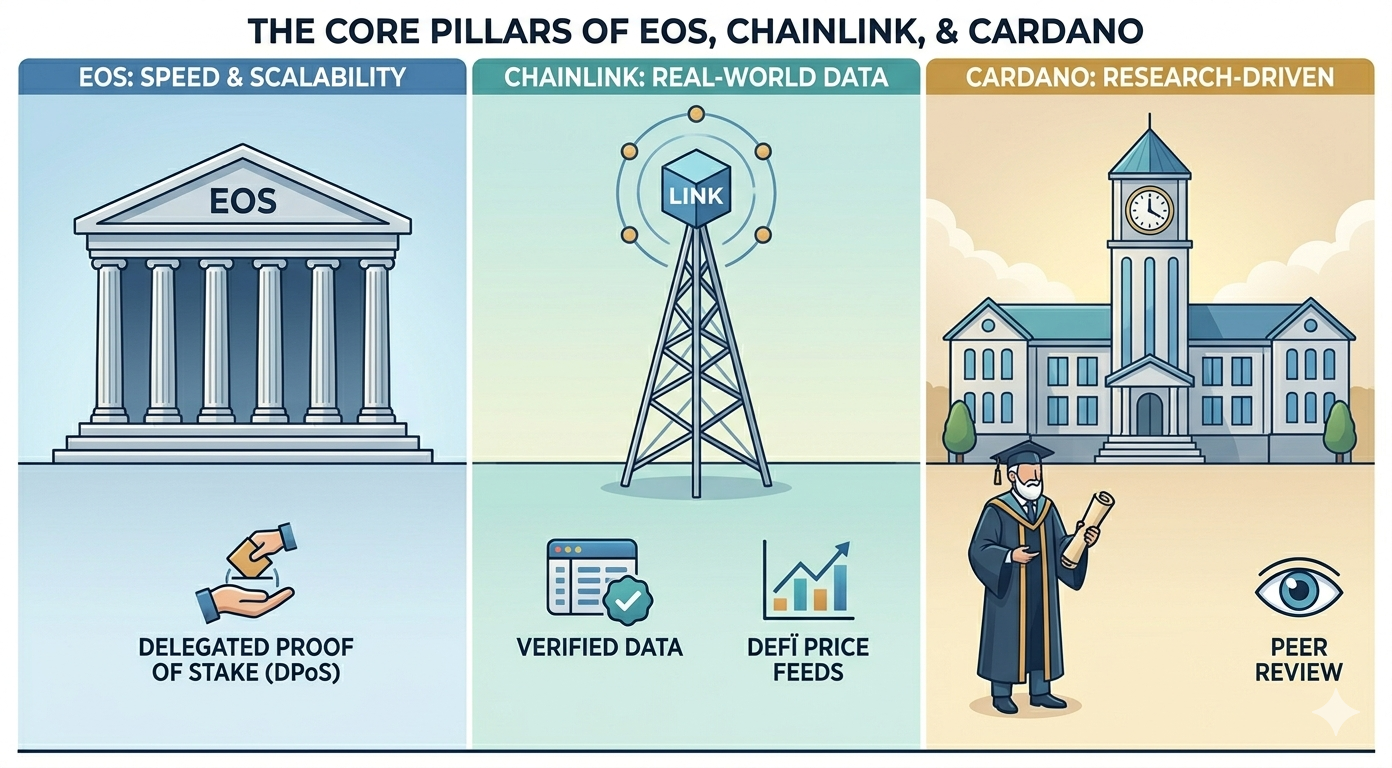
EOS, Chainlink, and Cardano illustrate three different strategies for improving blockchain technology.
- EOS: It majorly focused on performance and scalability, making blockchain stronger, capable of supporting decentralized applications with high-end developments.
- Chainlink: Its major part is to address certain challenges of connecting blockchain networks with real-world data. Chainlinks also allows smart contracts for ease of interaction with external systems.
- Cardano places emphasis on research, security, and long-term sustainability in blockchain through academic and peer-reviewed collaborations and development.
Lessons from These Blockchain Case Studies
- Scalability remains a key challenge in blockchain systems.
- Real-world data integration is essential for practical use.
- Strong security and governance ensure long-term stability.
- Community support drives adoption and innovation.
The Final Verdict:
All three EOS, Chainlink, and Cadano are significant developments in blockchain technology in the past few years. Each of them was introduced to solve different blockchain challenges that still exist in this crypto ecosystem. Whether it’s about improving the scalability or enabling the real-world data, or its integration to develop a secure and research-driven network, all these projects have made things easier and more convenient. In the future, it will expand beyond simple digital payments to help shape decentralized technology.
Source: Click Here