Mexico’s Silver Crisis Deepens: Cartel Violence Sparks Fresh Volatility in Gold and Silver Markets
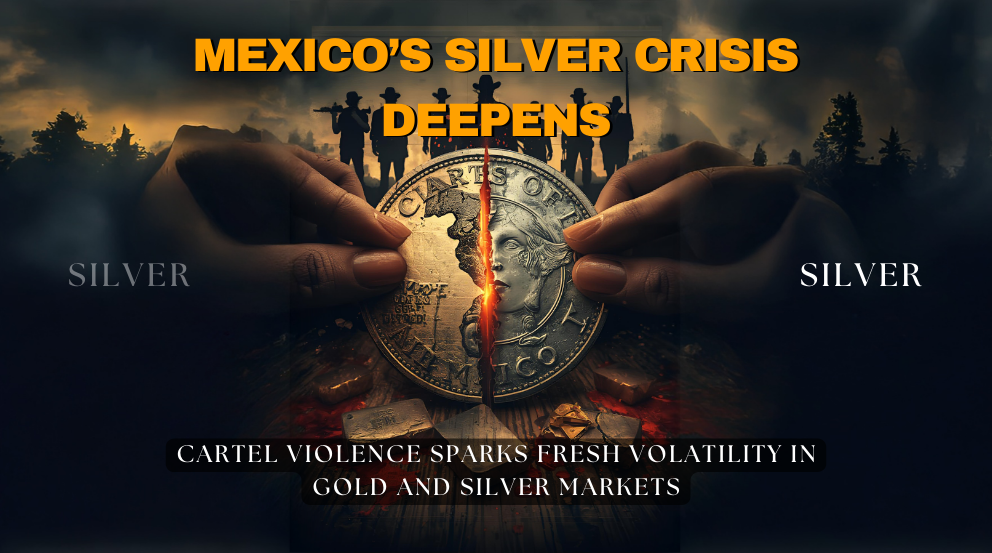
The rising cartel violence in Mexico is now having the first effects on the international precious metals market, with new concerns emerging about supply security, especially with regard to silver. What is now being described as the Mexico silver crisis is rapidly becoming a major theme for global investors.
In a large-scale military operation earlier this month, Mexican security forces killed Nemesio Oseguera Cervantes, the head of the powerful Jalisco New Generation Cartel (CJNG). Although the operation was hailed as a success by the government, its aftermath has led to widespread retaliation in several western states.
Road blockades, burning of vehicles, gun battles, and transport disruptions have been reported in key regions, some of which are also home to Mexico’s most productive mining regions. For global investors, this is more than a security issue. It is a potential supply risk that is fueling concerns of a wider Mexico silver crisis.
Silver Directly Affected
Mexico is the world’s largest silver producer, with a major share of global production. The major mining states of Zacatecas, Durango, Sinaloa, and Jalisco are crucial for maintaining a steady global supply.
If violence escalates or transport routes are further disrupted, several risks arise:
- Mine closures for security reasons
- Delays in transporting concentrate and refined metal
- Increased insurance and security costs
- Decreased foreign investment in exploration and development
The global silver market is already facing a structural deficit, which means that demand has been outstripping supply for the past few years. Even a small disruption in global production could further tighten supply and exacerbate the current Mexico silver crisis.
However, if the situation continues, the price of silver could become more volatile and even face upside pressure, especially if industrial consumers begin to aggressively hunt for silver.
Gold’s Response: Safe Haven Dynamics
The mining of gold is more geographically diversified. Mexico is not a major gold-producing country in the world. However, gold is highly sensitive to geopolitical instability.
Instability is usually associated with safe-haven buying. As investors become more concerned about rising political and security risks, they tend to turn to gold as a store of value.
In this scenario, gold could benefit from:
- Safe-haven buying
- Portfolio hedging
- Risk-off sentiment in the financial markets
In the short term, gold could become more volatile, but in the long term, it has always tended to perform well during times of geopolitical instability, especially when events such as the Mexico silver crisis raise questions about the stability of commodity supply. Mexico silver crisis
Why Some Analysts Say “Gold Is Risky to Carry”
When analysts say that gold is “risky to carry” recently, they do not mean that gold is a bad investment. Rather, they are worried about physical security.
In areas where there is unrest, the transportation of high-value commodities such as gold or silver becomes more hazardous and costly. Insurance premiums increase. Logistics become more complicated. Security arrangements become more stringent.
None of these factors are likely to decrease the value of gold but could increase the cost of doing business in the gold supply chain, adding another twist to what investors are now seeing as part of the emerging Mexico silver crisis story.
Market Implications
If cartel-related instability in Mexico continues, markets could see the following implications:
- More volatility in the price of silver
- Increased demand for physical silver
- Supply chain disruptions for industrial users
- Increased investor interest in mining stocks and ETFs
Silver is seen as more directly affected by the Mexican dominance of the world’s production. Gold, on the other hand, is likely to benefit from the increased perception of global risk associated with the growing Mexican silver crisis.
The Bigger Picture for Investors
Removing leaders from organized crime groups tends to cause fragmentation rather than immediate stabilization. Rival groups vie for territory and income sources, which can lead to short-term increases in violence.
This means continued uncertainty for mining activities.
Investors should pay close attention to:
- Security dynamics in key mining states
- Reports of operational disruptions
- Export and transportation updates
- Exchange inventory levels
Because the global silver supply chain is so highly concentrated, even a small crisis can have global implications.
Bottom Line
The current crisis in Mexico is a potential turning point for precious metals markets. Silver is the most directly affected market due to its high production concentration in Mexico. Gold, while less directly affected, may benefit from the increased perception of global risk associated with the growing Mexican silver crisis.
Whether this is a short-term blip on the screen or the start of a global supply crisis will depend on the rapidity of stabilization in the Mexican mining regions. For now, the Mexican silver crisis is a developing story, and markets are watching with interest.
Source: Click Here