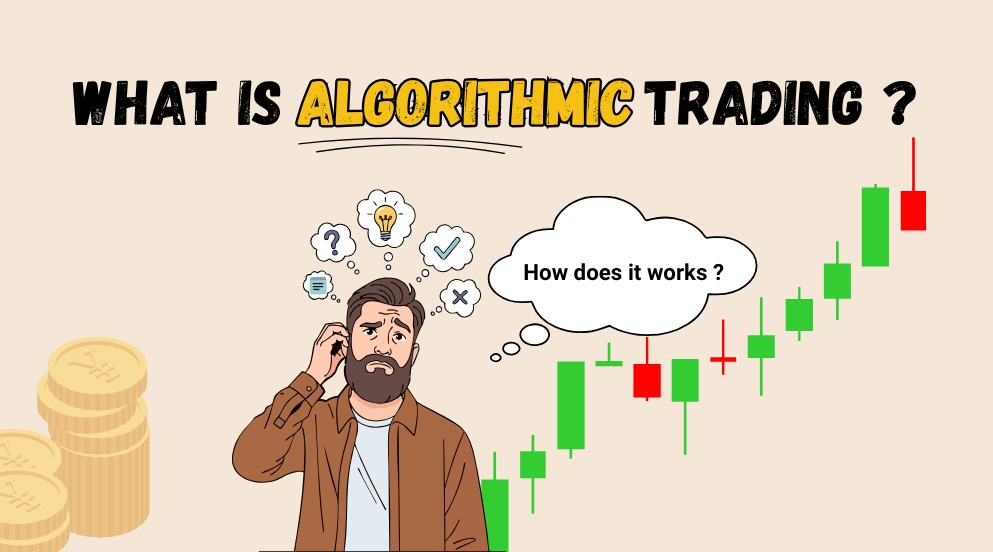
What Is Algorithmic Trading, and How Does It Work?
With the advancement in technology, financial markets have also changed significantly. Earlier trading was done manually by loud shout orders on trading floors or by placing calls to brokers on the phone, but it is now largely driven by computers and automated systems. Among many, one of the significant developments within modern financial markets is algorithmic trading.
This blog explains what exactly algorithmic trading is, how it works, and how it is used, playing an imperative role in today’s financial markets.
What Is Algorithmic Trading?
Algorithmic trading is a method that is used for executing trades via the use of computer programs that define the set of rules. Such norms are known as algorithms—they help in determining when to buy and sell an asset, how much to trade, and at what cost.
Rather than a human trader who manually analyses the charts and places orders, an algorithm helps perform the task automatically. Once activated, it supports monitoring market conditions and executes trades with zero involvement of emotions or manual intervention.
Algorithmic trading is widely used in markets such as stocks, commodities, forex, and cryptocurrencies.
Why Does Algorithmic Trading Exist?
The prime idea behind the algorithmic trading is its efficiency. The quicker moves in financial markets occur within opportunities appearing & disappearing within seconds. Of course, human traders can’t react as fast as computers, and algorithms help in the easy processing of larger amounts of data, identifying patterns and placing orders almost instantly.
Using technology in algorithmic trading speeds up the task and reduces delays, keeping lower transaction costs and supporting execution accuracy. The next important reason behind algorithmic trading is its consistency within strict rules that need to be followed.
Tech-savvy algorithms don’t panic, hesitate, or become unnecessarily greedy, which eventually helps reduce emotional decision-making.
How Does Algorithmic Trading Work?
Typically, algorithmic trading works by converting the trading strategy into a set of rules that are actually understandable by computers. Such norms are factor-based, like price, volume, time, or technical indicators. It starts with strategy development when traders build it on the basis of market trends and behaviour.
Later it can be translated into code by a developer or trader using a programming language. It eventually manages trade execution, position sizing, and often risk management – depending on how it’s coded.
Key Components of Algorithmic Trading
Algorithmic trading is actually built around various core components; first comes data, which includes price movements, volume, order book information, and even news or economic indicators. Secondly, on a defined set of rules for entering and exiting the trades in financial market trends, this strategy can be simple or complex.
Next comes the third core component, execution, which makes trades placed efficiently yet with minimal delays and cost. This is critical, as speed matters when trading gets into fast moves and quicker trends of finances.
Types of Algorithmic Trading Strategies
Precisely, there are various types of algorithmic trading strategies within the markets. The common type is the trend-following strategy, in which algorithms identify the upward or downward price trends with trades in the same direction.
Next comes the mean reversion strategy that assumes prices will return to their average level over time. Such algorithmic trading strategies buy when prices fall to their lowest and sell when costs rise too high.
The third algorithmic trading strategy is an arbitrage strategy, which exploits price differences over the same asset across different trade markets or exchanges. This is ideal, as it acts quickly before price gaps close.
Last but not least come the time-based strategies that execute trades within specific times, like market open or close, or spread large orders over the period to reduce the market impact.
Role of Speed in Algorithmic Trading
When it’s algorithmic trading, speed is precisely important, as it helps in better analysing data and placing trades within milliseconds or even microseconds. Speed helps traders or developers to take advantage of even small price changes that humans can’t react to within the quickest approach. It even becomes a strategy in high-frequency trading with increased competitiveness.
Algorithmic Trading vs Manual Trading
Manual trading relies on human performance, experience, judgement, and decision-making. Humans, while trading, do understand context and adaptiveness for unexpected events, as they are limited by emotions or slower reaction times.
Algorithmic trading keeps things more practical and tech-savvy, yet removes emotional bias. Its core focus is on the performance of strategies that improve efficiency in buying and selling, but it needs properly designed algorithms to avoid any losses or errors.
Advantages of Algorithmic Trading
Typically, algorithmic trading offers several perks such as
- Improves execution speed and accuracy.
- Lowers transaction costs.
- Helps traders and developers to test strategies using historical data that has been collected so far.
- Enables trading at a scale that is impossible to check manually.
- Support in real-time monitoring of multiple markets and assets at the same time.
- Keeps discipline within trades as follows: a strict set of rules that reduces emotional trading decisions.
Risks and Limitations of Algorithmic Trading
Apart from advantages, algorithmic trading also has certain potential risks, like tech failures, system crashing issues, connectivity errors, or unexpected losses. Algorithms also amplify the market volatility when many systems react to the same signals within the same period.
The poorly tested strategies impact the trading performance and even fail to detect and monitor real market conditions. Another risk is over-optimisation when the strategy is closely fitted within historical data and performs poorly in the future of trade and stocks.
Algorithmic Trading in Modern Markets
Algorithmic trading dominates the financial markets nowadays, as it helps in generating a large percentage of daily trading volumes in stock and forex markets. Financial institutions, hedge funds, and retail traders do use algorithmic systems.
In fact, the rise of online platforms and advanced accessible tools has made the use of algorithmic trading within larger financial firms and institutions. It is even popular in cryptocurrency because of its highly volatile nature and round-the-clock trading.
Future of Algorithmic Trading
There is a productive future of algorithmic trading because it’s closely linked to advancements and technological developments. In fact, today AI and machine learning are being integrated into stock and trading algorithms, making the trade sector more adaptive, accurate, and improved in performance.
However, there are certain challenges due to complexities, but evolving algorithmic trading developments would definitely shape assets on trades and prices.
Understanding algorithmic trading matters because it influences liquidity, volatility, and price discovery in the markets. Better learning helps traders or coders make improved decisions and adapt to modern market conditions.